Types of Solar Eclipses
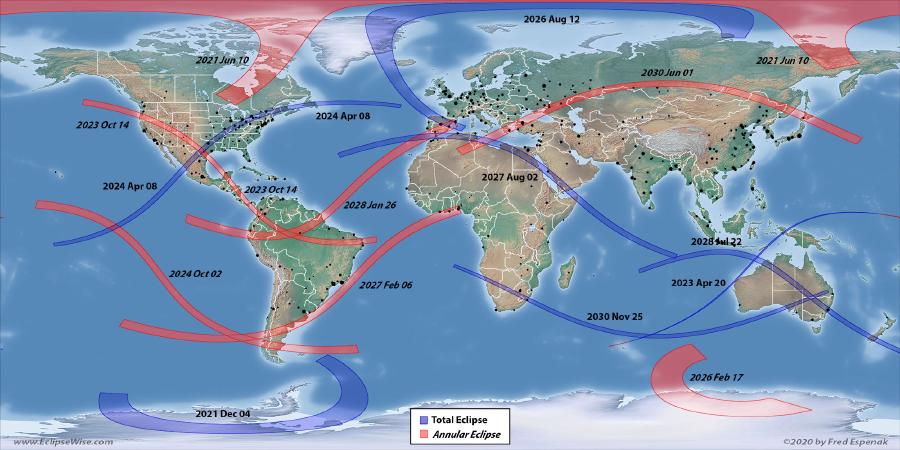
Solar eclipses occur when the Moon passes between the Earth and the Sun, casting a shadow on Earth. However, not all solar eclipses are the same. There are four main types of solar eclipses, each with unique characteristics:
1. Total Solar Eclipse
A total solar eclipse happens when the Moon completely covers the Sun, as viewed from Earth. During totality, the sky darkens dramatically, stars become visible, and the Sun’s corona (outer atmosphere) can be seen as a glowing halo around the Moon.
Key characteristics:
- The Moon appears to completely block the Sun
- Only visible from a narrow path on Earth (the path of totality)
- Lasts only a few minutes at any given location
- Can occur when the Moon is at or near perigee (closest to Earth)
Safety: During totality, it’s safe to look directly at the Sun without eye protection, but you must use proper solar filters before and after totality.
2. Annular Solar Eclipse
An annular solar eclipse occurs when the Moon passes directly in front of the Sun but appears too small to completely cover it. This creates a “ring of fire” effect, where a bright ring of sunlight remains visible around the Moon’s silhouette.
Key characteristics:
- The Moon appears smaller than the Sun
- Occurs when the Moon is near apogee (farthest from Earth)
- Creates a dramatic “ring of fire” appearance
- The Sun is never completely blocked, so proper eye protection is required at all times
Safety: Never look directly at an annular eclipse without proper solar filters - the ring of fire is still extremely bright and dangerous.
3. Partial Solar Eclipse
A partial solar eclipse happens when the Moon only partially covers the Sun, as viewed from Earth. This is the most common type of solar eclipse and can be seen from a much larger area than total or annular eclipses.
Key characteristics:
- Only part of the Sun is obscured by the Moon
- Visible from a much wider geographic area
- The amount of the Sun covered varies by location
- Can occur as part of a total or annular eclipse for observers outside the path of totality/annularity
Safety: Always use proper eye protection when viewing a partial eclipse - even a small sliver of the Sun can cause eye damage.
4. Hybrid Solar Eclipse (Annular-Total Eclipse)
A hybrid solar eclipse (also called an annular-total eclipse) is a rare type that appears as annular at some locations and total at others. This happens because Earth’s curvature causes the eclipse to transition between annular and total along its path.
Key characteristics:
- Starts as annular at the beginning of its path
- Becomes total in the middle section
- Returns to annular at the end
- Very rare - only a few occur per century
- The transition depends on the observer’s location relative to the Moon’s shadow
Safety: Follow the same safety rules as for total and annular eclipses, depending on which phase you’re observing.
Why Do Different Types Occur?
The type of eclipse depends on:
- Distance of the Moon from Earth: The Moon’s orbit is elliptical, so its distance varies
- Observer’s location: Whether you’re in the path of totality/annularity or viewing from outside
- Earth’s curvature: Affects how the Moon’s shadow falls on Earth
Viewing Safety
Regardless of the eclipse type, never look directly at the Sun without proper eye protection unless you’re experiencing the brief period of totality during a total solar eclipse. Use certified solar eclipse glasses, solar filters, or indirect viewing methods to safely observe any solar eclipse.
(Source: eclipsewise.com)
(Source: eclipsewise.
This post is also available in: Spanish, Russian, Ukranian, Belarusian, Portuguese, French, German, Italian, Turkish.